Showing posts with label special needs. Show all posts

Friday, June 10, 2016

A funny thing happened on our trip to Minnesota

Last weekend we were in Minnesota for my nephew’s high school graduation.  It was a quick trip because my youngest son is in school until June 17th!  Yes, you read that correctly.  

It’s always fun to go back.  We make it back to Minnesota at least once a year.  My husband and I are from a rural farm community (translation:  small town).  My husband and I graduated from the same high school that my nephew was graduating from.  My sister and brother-in-law graduated from there.  My husband’s three sisters graduated from there.  My mom taught in this school system.  I have two cousins who teach there.  We have a lot of connections to this town.

We flew in Friday and started on our 2 ½ trip to our hometown.  My sister-in-law picked us up from the airport.  We hit Jamba Juice on the way out of the Cities.  We stopped on our trip to have lunch with my mother-in-law and stepfather-in-law.  During this drive, my sister called and asked if we could come straight to their house to help set up a tent for the graduation party. Sure!

We arrived at their house and asked what we could do to help get ready for the party.  My sister-in-law and I were tasked with taping pictures onto the photo boards.  We were in the house working.  My husband, J, my sister and brother-in-law were outside putting up the tent.  S decided he would walk around their yard and check things out.  My sister and brother-in-law moved into this house about 9 months ago.  Not a problem.

We hadn’t been at their house for 30 minutes when my sister came inside laughing.  As they were outside putting up the tent, a cop pulled up to the house and sat there looking at what was taking place.  My sister walked over to see if he needed anything.  She said he seemed rather embarrassed; at this point, a second cop car pulled up to the house.  They had received a call that they needed to do a welfare check at the house.  Why?  Because S who has CP and uses crutches was walking around outside...by himself.  The horror of this!  

We all laughed at the situation.  S just wanted to know why no one bothered to ask him anything. Again, he was outside at 4:30 pm with 3 other adults and his 17 year old brother.  He looked like he might need some help (I need a sarcasm font here).

This made for a great conversation piece at my nephew’s party.  Everyone there either knows my son or knows of my son.  They know he is a college student.  Not really needing a welfare check. The biggest discussion was, “Which neighbor called the cops?”

The best part of this whole story is it made the police log in the paper!  You have to love small towns.  

I will be on the couch with chocolate...still laughing at this story.


Tuesday, July 14, 2015

Ummmm...You don't know what it's like.

My husband and I have two sons, J and S.  J will be a junior in high school and is starting to look at colleges.  S graduated last month.  He starts classes at the local community college next month.   He has paid his tuition.  He has purchased his books.  He has his bag for school.  He has attended the New Student Experience.  We have transportation figured out (kind of).


Our son has multiple disabilities.  He has Cerebral Palsy which impacts gross and fine motor skills and his speech.  He has ADD.  Last year he was labeled with Low Vision.  He doesn't drive.


We have been working with our son for years to get him to achieve his goal of attending college. A few years ago we created the "Four Pillars of Life", listing skills he would need to be independent and successful.  We made sure he had the proper courses in high school to prepare him for college.  We have called various agencies and talked to numerous professionals to make sure we were on the right path of finding appropriate services and getting them in place prior to this point.   Our son works with two Vocational Rehab counselors from two different agencies. He has Assistive Technology people helping him through three different organizations.


Even though we have been very proactive in this whole process, we are still sprinting through this summer trying to finalize everything.  We are taking S to meet with someone in an office somewhere at least once a week.  I think he has been at the community college every week this summer.  He is headed over there again tomorrow.  


A recent conversation
The other day someone we know was asking S about his plans.  He told her that he was attending community college this fall working toward an Associate of Arts degree with a History focus. He intends to transfer to a 4 year school when he is finished at the community college.


This woman came up to me afterwards and said that S had been telling her his plans. I said we had been crazy busy this summer trying to get everything into place for him.


Her:  "Oh, I know what it's like."
Me:  Ummmm........(killing time....dramatic effect....trying to figure out how to respond)....


[What I wanted to say:  You do know what it's like to send your son off to college but you have NO IDEA what it is like for us.  You don't know what we are going through to send our son to a school 20 minutes down the road.  You didn't have to come up with a game plan more than four years ago just to try to get services in place that we are still working through, and S got a new label and a new organization thrown in his lap last year.  You haven't had to deal with all of these agencies that are known by a group of letters.  Your son doesn't have to keep a binder full of paperwork from all of these organizations in addition to doing the required stuff for college.]


What I said:  There is more involved than just sending him off to college.
Her:  Oh, I'm sure you have to do a little more.


Yup!  That's right.  A little more....


You will find me on the couch with chocolate (and possibly wine) because, if you are reading this, you know what it's like.


Tuesday, June 9, 2015

An essay from my son: I have been able to be successful.

My son had to write an essay about himself this fall.  I think he did a great job of explaining himself.  I asked him if I could use it on my blog, and he gave me permission.  I have been hanging onto it waiting for the right time.  That time is now.  My son is graduating this weekend.  

You will find me on the couch with chocolate celebrating this milestone in my son's life. He has worked very hard to get here!

I have been able to be successful.
  “Neither this man nor his parents sinned,” said Jesus, “but this happened so that the works of God might be displayed in him.” (John 9:3 New International Version (NIV)) This was my confirmation verse and it has a special meaning to me because I have multiple disabilities. I’ve been able to be successful because of the people God has put in my life to help me on my journey. I think it is important to advocate for people who have disabilities, so they also have the chance to succeed in life as I have had so far.
I have three disabilities: CP, Low Vision, and ADD. My CP affects everything. However, the CP primarily affects my arms and legs. I started out using a walker. Now, I walk with crutches and I can also walk with one crutch. I can even walk short distances without any support. I use leg braces to help keep my legs straight when I walk. I use my own personal manual wheelchair to save energy and get around quickly when I have to travel long distances. I have always had problems with my vision; however, I recently received the label Low Vision. In the fourth grade, I was diagnosed with ADD. Even with my disabilities, I still have been successful in my life so far.
The reasons for my success are my parents, doctors, therapists, friends, other people and Faith. My parents have battled school systems to ensure that I’ve gotten a good education like everyone else. One school district suggested that I needed to be in a special school as a result of my disability. My parents said no and that I would be attending a regular public school. I have had good doctors and therapists. I have friends and other people who have helped me when I’ve needed help. My friends have made sure that when they plan activities that I can participate as well. At the end of the day, the number one reason why I am successful is because of my faith in Jesus Christ. I always pray for a better tomorrow, especially on the days that I’m physically struggling.
I think it is very important that all children and adults who have disabilities get the services and tools that they need in order to be successful. If they require certain adaptations in order to get tasks done and make their lives run smoothly, I think steps should always be taken in order that people with disabilities have access to them. If a person with a disability requires therapies, medications, or medical care, then I believe that steps should also be taken to ensure that they can gain access to them quickly without getting the run around from other people. I think it's very important to advocate for those who have a disability because I believe that everybody deserves a chance.
In conclusion, I do have a unique combination of disabilities. I have been able to be successful so far in life because I have had some help along the way. Everybody deserves a chance like I have been given.

Wednesday, May 13, 2015

Take your test scores and.....

Anyone who has a child with special needs has been down the path of testing your child.  The reasoning behind the testing is something like this, “We must test your child so we can see exactly where they are to provide the best education placement possible.”

Having been a former Special Education teacher, I kind of get this thought process.  However, having been a former Special Education teacher, I also know that the test scores don’t give me the complete picture of the child.  I needed to work with the child, talk with the child, observe the child, etc.  The test scores played a very small role in the overall picture.  

And yet….
there is so much emphasis placed on test scores.  You want to label my son, who has multiple disabilities which makes testing him very difficult, and tell me how successful he will be based upon these scores that aren’t normed for a child who has fine motor issues which cause problems with timed tests or vision problems.  

When S started school, we didn’t know for sure how much of an impact his CP and vision issues had on his intellectual development.  We were also dealing with the fact that English was not his first language.  He was adopted from Bulgaria at the age of 4.  Fortunately, we were working with a team that understood all of this.  Just in case they didn’t, I had printed multiple articles off of the internet addressing the issue of testing children who were adopted internationally.  

However,
there is always one person in the meeting who thinks the test scores are “it”.  That person, in this particular meeting, was the school psychologist.  She started spouting numbers like they were written in stone.  I, of course, had already flipped through all the pages to see what the end results said, and it wasn’t pretty.  Had we placed S in an educational program based upon these numbers, we would not be talking about him getting ready to graduate and going to college.  I would not be blogging about his love of History and Foreign Languages.  I would not tell people how he is currently taking German IV and took a year of Russian.  

However,
the rest of the team just wanted a baseline from which to work.  There was no question about his intelligence from them because they had all worked with him individually.  The test scores allowed them to check the box that said they had tested him.

We know that we were lucky to have the overwhelming majority of the team on S’s side.  They wanted to see him succeed academically.  They pushed him to do the best he could in school. The director of Special Education asked me one day if they were pushing too hard.  
“We just want him to be successful, and we don’t want him frustrated.”  
“Oh, you will know if you have pushed him too hard.  It will be VERY clear.”

And then,
we moved.  He was tested again.  

And then,
we moved again.  He went through a triennial review which is hours of testing.  

And then,
we decided to homeschool and that testing stopped.  How nice!  No numbers swirling around anywhere trying to determine what my child can or cannot do.  No numbers trying to dictate his future or educational placement.  

Because we homeschool, we do have to test him at the end of every school year to show progress to the state.  

The numbers are just that….numbers.  They don’t tell me anything I don’t already know.  He has a very strong vocabulary.  He doesn’t do as well with grammar (commas are not his friend).  He does well in math...as long as he writes the problems out and doesn’t try to solve everything in his head.

But now,
as we prepare to send him to college there is a great deal of emphasis on “THE TEST” whether it is the ACT or the SAT.  

However,
in order to get the accommodations S was going to require for either of these tests, we needed current testing data on him. We took him for psychoeducational testing.  So, he had to be tested before the test.  Is that as clear as mud?

Again, the results did not tell us anything we didn’t already know.  Every accommodation that was recommended was exactly what we had told the psychologist he would need.  [I am not hacking on this psychologist.  We brought S in there for this exact purpose.  This doctor was very nice and understood exactly what we were trying to do.]

In the end,
we decided that S would not take the SAT or the ACT. Taking the ACT or the SAT is not going to prove to anyone how well S will or will not do in school.  Only by working with him, talking to him, watching him, understanding how much time and effort he puts into his schoolwork will anyone understand how successful he will be.

Instead,
he will take the placement tests at the community college which is where he will start school in the fall.  We are hoping this will be done in the next 2-3 weeks.  He is working to get his accommodations in place at this point. This is a much easier process and less stressful for him.

So,
you can take your test scores and……find me on the couch with chocolate.

Thursday, March 12, 2015

Therapy in the Kitchen

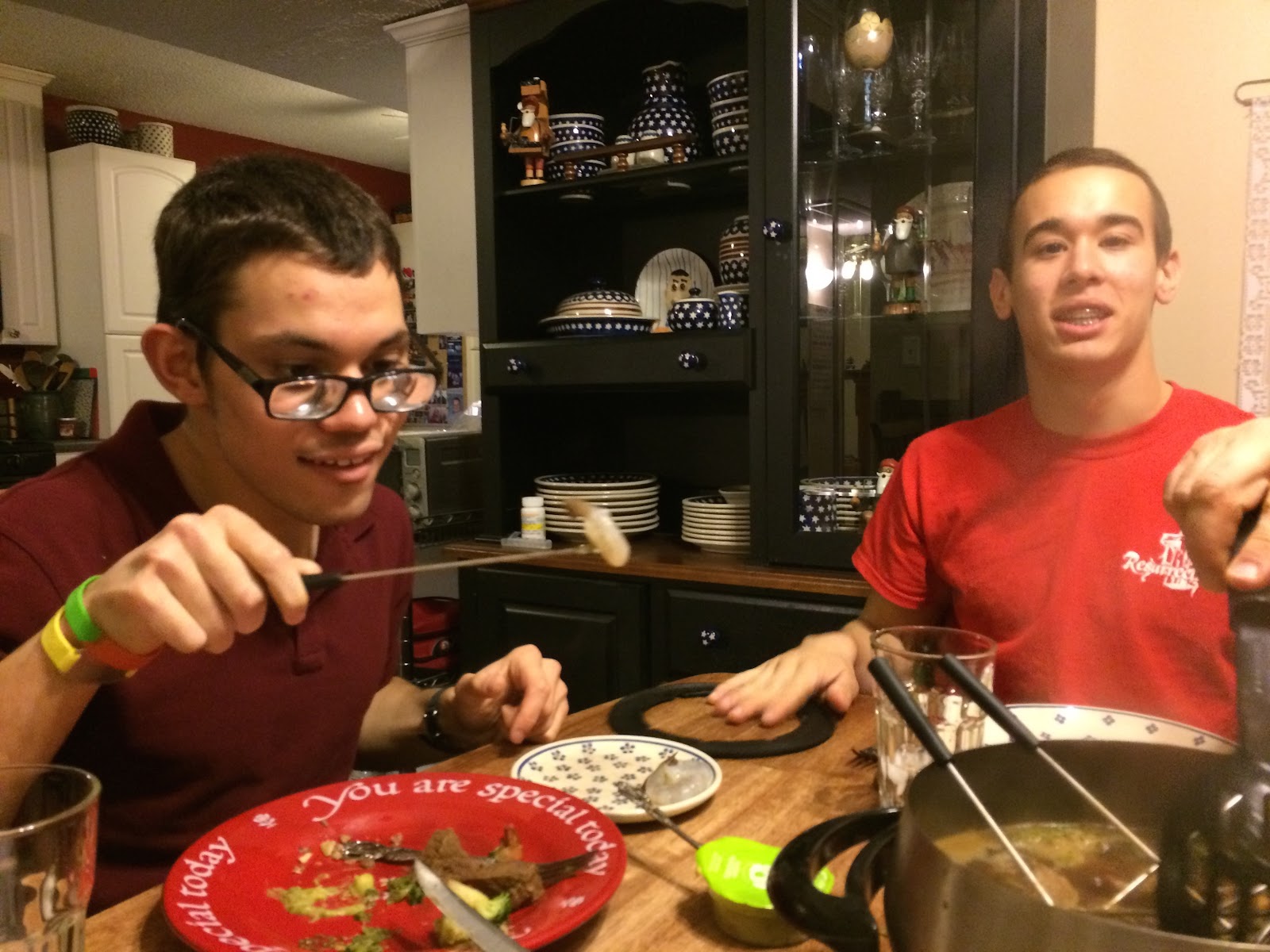
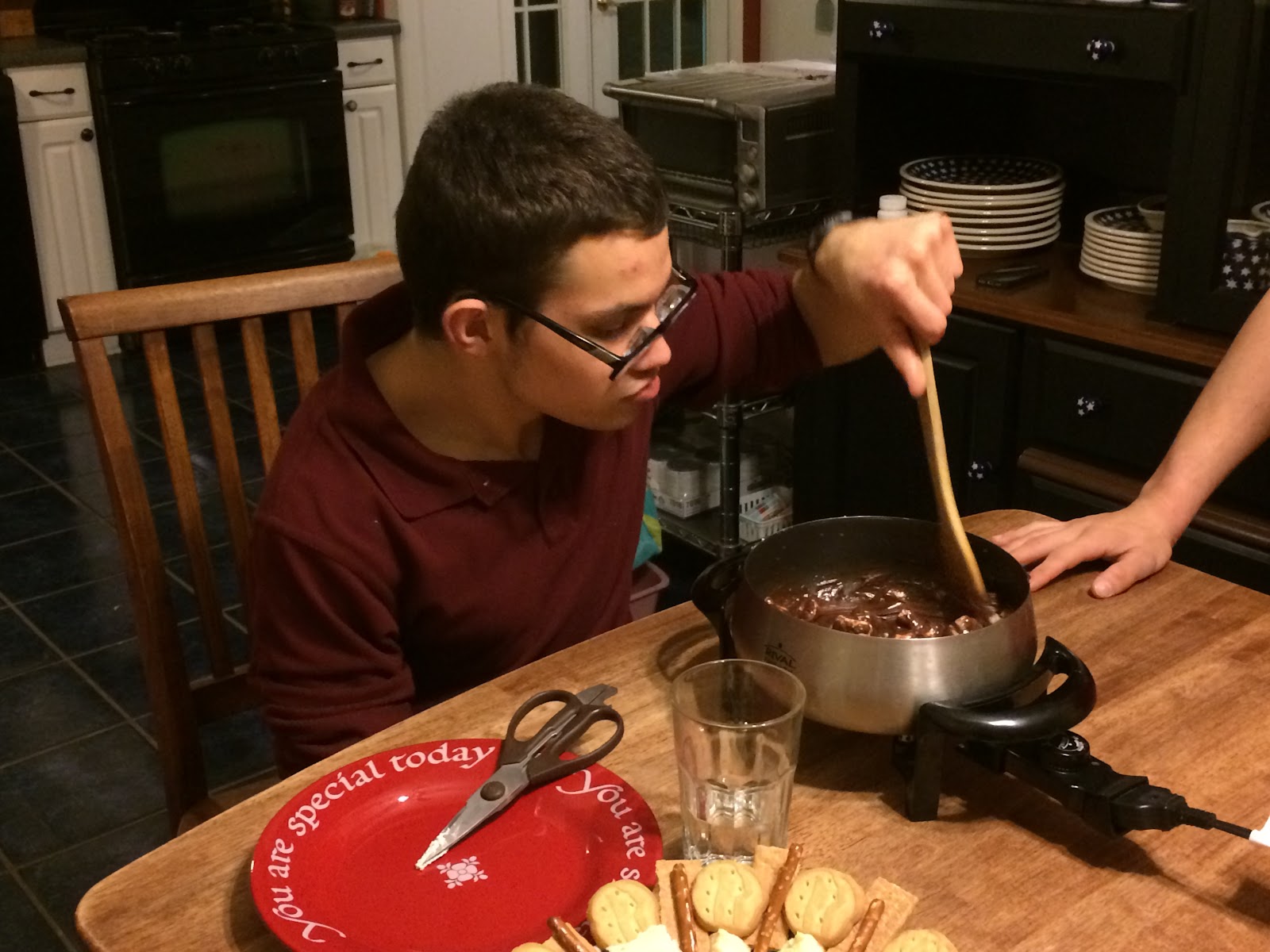
When we were celebrating S’s Gotcha Day with fondue, I was watching him stir the pot, literally, and I grabbed my phone to take a picture. 
“Really, mom?  What could you possible blog about with this?”  
Oh, I had an answer. "Cooking and therapy - a perfect match."

IMG_1046.jpgIMG_1048.jpg


IMG_1050.JPG


When S was a fifth grader, he worked on food preparation skills in Occupational Therapy.  He exited OT as an early middle school student.  Last year, we had him start again.  We asked that they work on helping him with cooking skills and strategies.  S’s goal is to live independently; therefore, he needs to be able to eat.  Contrary to his thinking, food just does not appear in the refrigerator in single serve reheatable containers.


Last year's Occupational Therapy services were very beneficial to him.  The OT has children who are college age, so she was able to provide S with real world examples of the need to cook.  She had him preparing different food items for the staff at the clinic (biscuits, brownies, etc.).  One day we met at one of this organization's Rehab facilities so she could monitor him in a full size kitchen.  She was impressed with how much he could do.  It also showed her areas to continue working with him.  


One of the most difficult areas for S is baking.  There is a lot of planning and movement around an oven.  The OT brought in a toaster oven for him to try.  That worked very well.  S now has his own toaster oven.  When he uses it, he puts a chair in front of it so he can sit while he is maneuvering pans in/out of it.


We have S prepare single serve containers of food items from larger quantities:  yogurt, granola, meal items. We also have him cook large meals and divide things up. He is a fan of "one bowl" meals. He will mix all kinds of things together.


Through the years, we have tried different kitchen items for S.  In addition to his toaster oven, he likes the following:
Ove Gloves :  S loves these for his toaster oven!  Oven mitts are difficult for him to put on, and he feels unsure of himself when he is wearing these.  With the Ove Gloves, he is very comfortable working with the toaster oven and hot pans.  If he is comfortable, he is relaxed.  If he is relaxed, his tone doesn't kick in.  If his tone doesn't kick in, he can move much better.
Pampered Chef Small Micro Cooker:  This has a handle and a lid.
Rubbermaid containers:  These are S's best tool in the kitchen.  It allows him to carry his food without spilling as he walks (remember he's walking with crutches).  
Tervis Tumblers:  Easy for carrying drinks.
Ziploc bags

For S, the therapeutic benefits are extensive.  He is working fine motor (cutting, stirring, peeling, measuring, pouring), gross motor (moving around the kitchen safely), motor planning (how to carry things from A to B), executive function (what items do I need, creating lists, planning a shopping trip), and paying attention to time (how long does something need to cook and what else needs to be done in that time).

I think I will hang out on the couch with chocolate and let S work in the kitchen.


Linking up with:


Wednesday, March 11, 2015

The "Great Big Book of S".

As a parent of a child who has special needs, I feel like I need to be prepared for whatever life throws at us.  I, along with my husband and other parents of children who have special needs, are asked to do many things for our children.  We are asked to be advocates for our children in the educational arena.  We are asked to convey medical information between specialists.  We are asked to schedule numerous appointments with therapists and coordinate insurance referrals.  We are forever filling out paperwork for some office or agency and dropping it off at the clinic so our doctor can sign it.

As a former Special Education teacher, I knew the importance of keeping all of S's documents. In meetings, I would tell parents that they needed to keep all of the papers together .  What I didn't know was the volume of paperwork that these parents were handling.  Also, it's not always clear divisions of paperwork.  Sometimes medical crosses into educational and vice versa.  

What has helped us stay sane throughout all of this?  We have what we call "The Great Big Book of S".  Through the years, we have compiled 3, 3-inch, 3-ring binders filled with S's information. 

We learned the organization techniques for S's book through Pam and Pete Wright's book, From Emotions to Advocacy, http://www.wrightslaw.com/nltr/12/ss.organize.file.htm, and additional helpful reading from http://www.wrightslaw.com/. We have adapted these techniques as we have needed for our situation.

*What goes into the "Great Big Book of S"?
1.  Anything pertaining to S and his care
2.  We have a list of all of his providers with phone numbers, fax numbers, addresses, and email addresses.  My husband has a copy of this document at work in case he needs to make phone calls.
3.  We have a plastic protector to hold any business cards we receive from providers.
4.  Medical reports
5.  Documents from school (IEPs, report cards, notes from the teacher, etc.)
6.  Any testing reports (school or elsewhere)
7.  Copies of any correspondence from us to others about S
8.  Insurance referrals
9.  Copies of prescriptions


*How is the "Great Big Book of S" organized?
1.  Organize everything chronologically.
2.  Create a "table of contents" for your book.  
3.  We printed calendars and put in the binder also to record appointments and meetings.  That was very helpful for us.  
4.  We used sticky flags to mark new months, so we could find things easier..


*How is the "Great Big Book of S" beneficial?
1.  There is a definite attitude shift on the part of professionals when they see us whip out the book(s).  We have traveled with some large bags to get these books to appointments.
Example of the benefit:  
Shortly after moving to Virginia, I attended a triennial review for S by myself since my husband was gone.  I came in with my bag full of binders, notebook, and pen.  Since we had just moved, I was talking to the team members from the school discussing S's transition.  An administrator from the district office came in, looked around, visited with everyone, and said that the meeting could start as soon as the parents arrived.  Imagine her surprise when she found out mom was there already..

2.  It saves our sanity to know that we have S's documents all together, and we don't have to dig for them.
Example:
A couple of months ago, we received a statement from the insurance company that they had paid a medical bill for S...to a gastroenterologist.  The problem is he has never seen a gastroenterologist. The date of service was the day he saw the ophthalmologist.  This was a call to the insurance company which was made much easier because we had the insurance referral, the medical bill, proof of our co-pay, and now this statement all together in one spot.  

3.  We are going to be able to hand him the books as he becomes an adult, so he has necessary information together.   Since he is now 18, I have started to weed out some of the documents. He probably doesn't need Explanation of Benefits from bills that were paid 12 years ago.  

Thank you Pam and Pete Wright for teaching us how to organize our book!  Their book, From Emotions to Advocacy, lays it out quite well.  It is a lot of work initially, but it is such a timesaver and lifesaver!  

Because their system made my life easier since S's paperwork was so well organized, I have free time to be on the couch with chocolate.


Wednesday, February 25, 2015

How do you keep him motivated?

My youngest son, J, is a gymnast.  He is in his seventh year of competing this year. We have learned through the years that boys' gymnastics is a small, supportive community, and we have had the opportunity to meet many families from various gyms and states during this time.  


At J's meet this past weekend, I had a mother from another gym approach me.  Her first question was, "Was that your son who just competed on rings?"  I guess my obnoxious hooting and hollering after my son finished his routine gave me away.  [I do need to clarify that he stood his landing up which has been a challenge for him this year since he has a more difficult dismount.] Anyway...I told her that was my son.  She complimented his routine (told you - very supportive). Her next question was,


How do you keep him motivated?
I didn't even hesitate when I answered.  I don't.  My husband doesn't.  Everything my son does in the gym and at meets comes from him.  We encourage him, and we support him; however, he has to motivate himself.  She said that her son is losing motivation, and they are trying to figure out how to motivate him.


That's tricky.  I can't make my son work in practice or do his best at meets.  He has to want that. He has to work hard.  We have told him when it is no longer fun, then it is time to quit. Our family has invested too much time in J being a gymnast for him to continue when it isn't fun - he practices at a gym 45 minutes away 5 nights/week.


This conversation made me think about S and motivating him to do the right things for himself - stretching, becoming independent, etc.  


What are the parallels?
The special needs community is a small, supportive community.  We have had the opportunity to meet some amazing families throughout our various duty stations, travels, and activities.  


No other parent will get what you are going through like that of another parent of a special needs child.  They will celebrate that milestone achievement that to others seems miniscule. They will empathize with you when you talk about battles with the insurance company or schools.  They will understand your desire to find that "something" that will help your child.


What are the differences?
With J, we tell him when it isn't fun then it is time to quit.  We can't tell S that.  Most of what he has to go through on a daily basis isn't fun, but he can't quit.  It is at that time he must work even harder.


J's activity is just that - an activity.  It is something he chooses to participate in.  S's disabilities aren't anything he chose as he likes to clarify for us quite often.  They aren't an extra activity that he gets to do for fun.  This is his life - every day, 24/7, 365.


So, how do we keep him motivated?
This is more of a challenge.  Yes, the motivation has to come from him, but it isn't always going to be as easy.  We have had to provide a lot of encouragement and some extrinsic "motivation" along the way.  That motivation changes as the child grows up.


When S was young, it was easy to make him stretch every day.  It was what had to be done whether he liked it or not.  If he didn't do it, he lost things.  When S was in Pre-K, we stretched before he went to school.  During that time, he could watch The Wiggles.  If he didn't stretch nicely, we turned the TV off.  If he still didn't stretch nicely, he didn't get to ride the bus to school. If he didn't ride the bus to school, the whole school knew he was having a rough morning.  The principal would meet him at the front door of the school when I brought him to school.  That was motivation to stretch nicely.


Through the years, tactics changed.  It became more of "when you stretch nicely, then you will get _____".  As he continued to become older, his PT told him that it wasn't up to his parents to stretch him.  He needed to stretch himself.  This has been challenging.


There hasn't been much motivation for him to stretch himself.  He is lacking in the "wanting that for himself" department.  He knows why he needs to stretch.  He knows the ramifications of not stretching.  We encourage him to stretch.  We have given suggestions to try to make it more fun.  We tell him that we also need to stretch.  He sees us stretch and exercise.  


He has been better the past few weeks.  He can tell a difference when he is stretching.  For him, that has to be the motivator - "If I stretch, I feel better."  It is that simple.


Regarding his motivation with his ADD, he knows that taking his medication helps him.  He also knows other strategies that help him to work efficiently.  Just because he knows them doesn't mean he always uses them.  He has to be motivated to do so.  He has been quite motivated to get his work done lately because he can visualize on the calendar the end of his school year. Although he isn't excited about graduating, he is excited about being done with school especially before his brother finishes the school year.


Regarding his Low Vision, he knows what tools/techniques are helpful.  He wants to see better, so he is pretty motivated about using those tools.  There was a time period that he wasn't excited about bumping up the font size on the computer, so he could see text better. He now knows it is a helpful technique.


Really, the issue is motivation regarding his Cerebral Palsy.  I can understand that.  It is taxing on him.  It is physically demanding for him to get through a day doing day-to-day tasks. However, not doing the right things for his body isn't going to make it go away.  It is just going to make life more difficult.  I hope he continues to stretch and remembers that stretching makes him feel better.


I will be on the couch with chocolate encouraging my sons to do their best (and continuing "mom motivation" if need be).

Thursday, February 19, 2015

Hippotherapy or Therapeutic Riding

For this Therapy Thursday, I thought I would write about our experiences with hippotherapy and therapeutic horseback riding.  My son has been a client of both hippotherapy and therapeutic horseback riding.  Both have been good for him.  They have each provided him with different benefits at different times in his life.


What is the difference between hippotherapy and therapeutic riding?
Hippotherapy provides therapy services (PT, OT, and/or Speech) on horse.  The focus is on the therapy.  It is not riding instruction.  Our insurance paid for this.


Therapeutic riding is focused on teaching riding skills.  Although there can be therapeutic benefits, there isn't a therapy focus.


Hippotherapy
S joined our family when he was 4, and we lived in Alabama.  The Special Education team at his school told us that the PT who had the contract to serve the school also had a private clinic which provided PT, OT, and Speech.  This clinic had a traditional clinic setting in which play was emphasized for the children to work on their skills, and they also used hippotherapy.


This was amazing for S!  He was a client there for 3 years.  For a young child who is going to therapy twice a week for 2 hrs/visit, what a great opportunity!  He had PT at both visits, OT at one visit, and Speech at the other visit.  


Twice a week he did hippotherapy for part of his visit, and the other time was in the clinic. They rotated which service was done as hippotherapy. The team he worked with was amazing!  


Therapeutic Riding
S is in his sixth year of therapeutic riding.  We have a friend who used to volunteer at the facility S rides at now.  She had been telling us for a couple of years prior to S starting there about the program.  He kept saying he wasn't going to do therapy on horse.  It took a while for him to realize that they were going to teach him riding skills.  He said he would try it, but he was NOT going to do therapy on horse!


The staff at the facility laughed at this.  He was right.  He wouldn't be doing therapy on horse; however, he would definitely get some therapeutic benefits from riding. Long story short, he loves it!  


For S, both hippotherapy and therapeutic riding have been beneficial.  He had each service at the right time in his life with the right people.

You will find me on the couch with chocolate and fond memories of good times and good people in our lives.

Linking up with:


Wednesday, February 18, 2015

An Uncomfortable Sermon

A few weeks ago at our church we celebrated “Sanctity of Life” Sunday.  One of our pastors preached a very passionate sermon on the sanctity of ALL life:  unborn children, elderly, and those who have intellectual or physical disabilities.  As he was preaching about society’s view of the disabled and time periods in which disabled people were viewed as expendable, he used S as an example of someone whose life could be deemed as less worthy than others. After church, he apologized to me for not talking to us about using S as an example first.  

No apology needed.
  1. S is now an adult.  You don’t need to talk to us.  
  2. S feels very strongly about this topic also.  The research paper he finished in December was on the Nazi’s T-4 Program in which elderly people and people with disabilities were systematically killed.  So, his response to me was, “If using me as an example makes people realize there is a problem, then use me.”  
  3. This pastor and S have a very unique relationship, and they have discussed S’s disability before.  When S was in the seventh grade and attending Confirmation class, the class discussed what they thought heaven would be like.  S told the class that in heaven he wouldn’t need crutches, and he would be able to run like everyone else.  

A Reaction
A few days after this sermon was preached someone from our church called my husband to talk to him about S being used as an example.  He didn’t think it was right.  This person felt that it could skew people’s views of S by drawing attention to his disability.  He said he doesn’t think of S that way.  He was very complimentary of S’s intelligence and contributions he brought to the adult Sunday School class on the history of the church.  We know that this person is a kind and caring person who called out of love and concern.

S’s thoughts
S heard my end of the conversation with my husband after he spoke to the concerned person from church.  

  1. Again, he said, “If using me as an example makes people realize there is a problem in this world, then use me.”
  2. He likes being known as S - not the person with a disability.  He appreciates people looking past his crutches and getting to know him as a person.  However, S the person still has a disability that needs to be taken into account regarding mobility and vision issues in the church.

Our thoughts
  1. You can’t draw attention to S’s disability.  S’s disability is pretty visible.  
  2. While it is intended as a compliment that this person doesn’t see S that way, the reality is that S has a disability.  We appreciate the fact that many people have looked past his disability to see S as a person.  However, people need to realize that we have parishioners in our church who are disabled, and it impacts their ability to get to church and get around the church, participate in various activities, see the screen during worship, hear the service, etc.  
  3. If our pastor using S as an example made some people uncomfortable, good.  I’m glad that it bothers you to think that just because my son has a disability that some people in this world have viewed or continue to view him as expendable.  I’m glad you have come to know him and know that it would be a loss in everyone’s world if S was not here.

We are blessed to be in a church that is filled with loving people looking out for others.  

You know where to find me - on the couch with chocolate.