Showing posts with label fine motor. Show all posts

Thursday, March 26, 2015

Therapy with Games

During our many snow days last month, we played a lot of games.  When J pulled out the game Trouble, it took me back to a time in Alabama when we realized S couldn’t push the bubble on the game to roll the die.  His Occupational Therapist told me to bring the game to therapy, and they would work on it.


Any type of game is beneficial for S because of the fine motor skills involved - holding cards, sorting cards, rolling dice, organizing and manipulating dominos, pushing the bubble on the Trouble game, moving game pieces.  Games can also be beneficial for vocabulary, math skills, logic, and strategy.  Games involving speed tasks are difficult for S.  Pictionary is a challenging game for him also; however, it is still beneficial.


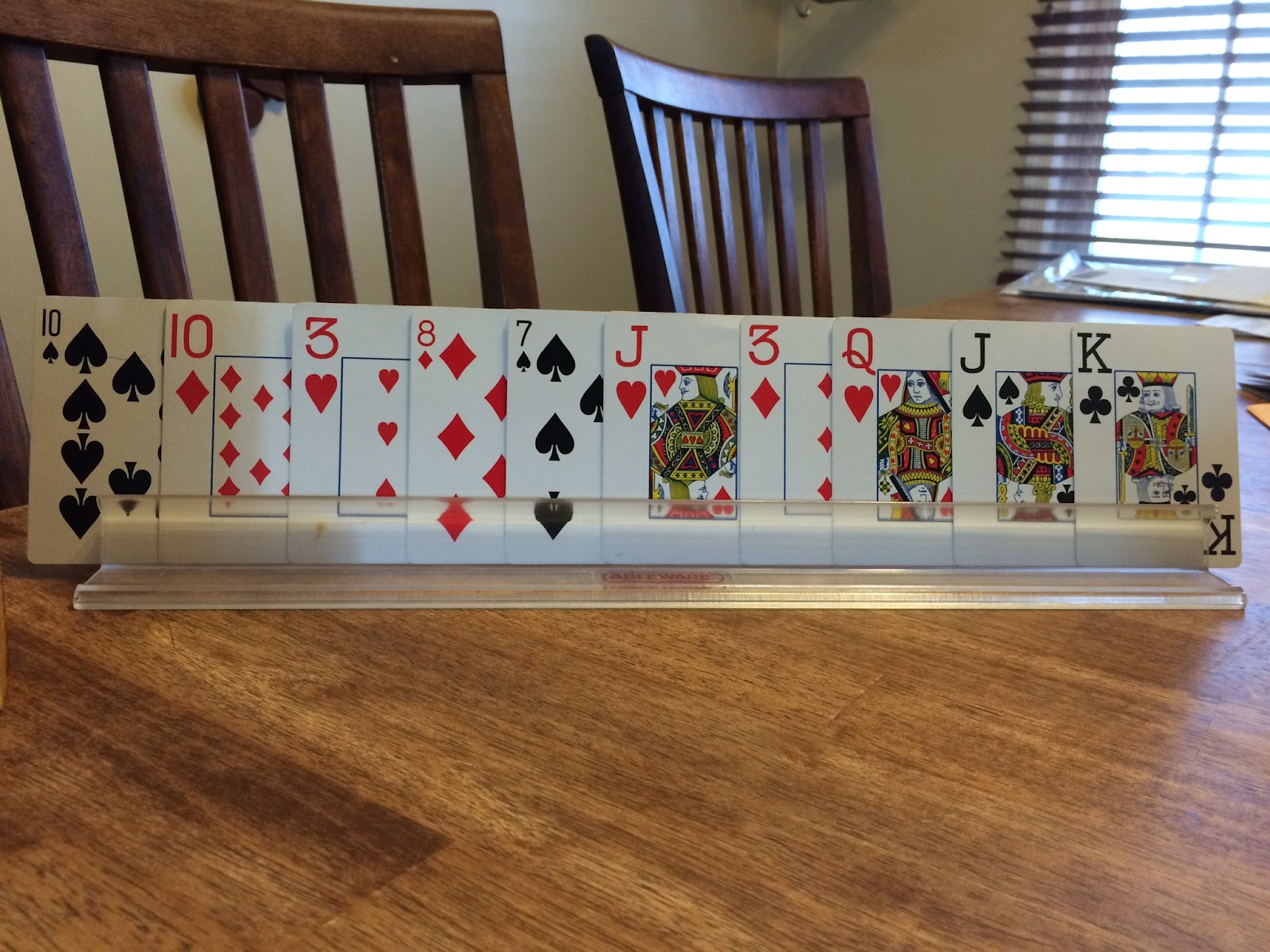
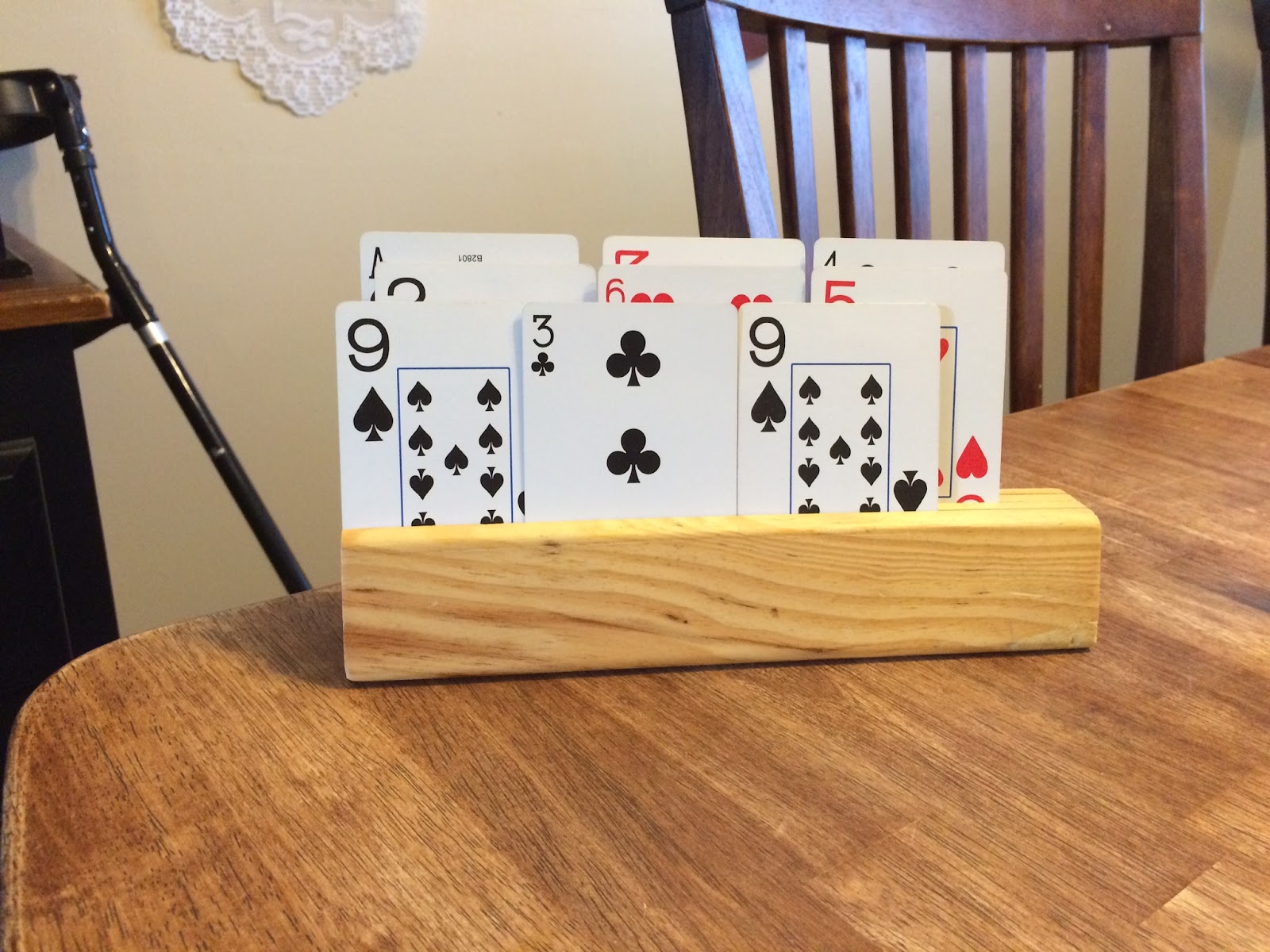
S tends to pick dice games over card games.  He enjoys cards but manipulating the cards can be a task.  We have two different card holders for him.  He prefers the one that holds the cards in a straight line.  It is easier to put them in.


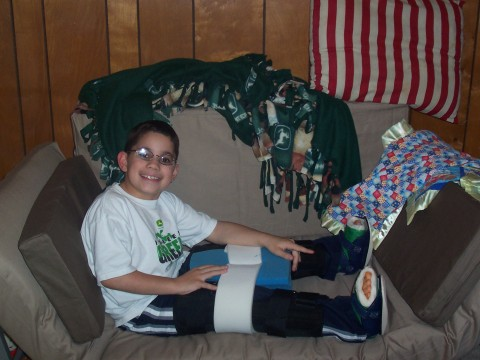
IMG_0055.jpgIMG_0054.jpg


He also enjoys playing dominos.  We have domino holders to help organize his dominos and make it easier to manipulate them without knocking them over.  He will not create a train for his dominos.  Not sure why.  If we help him create one, he doesn’t follow it.  


Games in Minnesota
When we were in Minnesota for Christmas, we played a lot of games.  During one card game, my cousin, who had worked on her doctoral degree in Special Education, was sitting next to S. She just kept shaking her head.

The following conversation took place between my cousin and me:
What’s up?
I just can’t figure this out.
What?
I have no idea how he is organizing his cards.  I can’t figure it out.  It doesn’t make any sense.


S laughed because he was beating all of us at this point.  He then proceeded to tell us, “I am an enigma and can’t be figured out.”


Although playing games is fun, it is also a great tool for therapy.  Fun and good for my child.  I like that combination!


S’s Favorite Games
Fill or Bust
Dominos
Spinner Dominos
Apples to Apples
In a Pickle
Ticket to Ride
Risk


I will be on the couch with chocolate enjoying some family fun time.


Linking up with:


Wednesday, March 25, 2015

Save the Best for Last: My Son's View on Having CP

Every week this month, I have interviewed a member of our family about Cerebral Palsy.  I wanted to kick off the series by interviewing S, but he wanted to be last.  I believe he uttered the phrase, “Save the best for last.”  I honored his request and saved him for my last interview. It has been interesting for our family to dig deep and answer these questions honestly.  


What is your diagnosis?
I have Cerebral Palsy Spastic Diplegia (We found in paperwork we have been gathering for SSI that somewhere along the way doctors re-labeled him as having Spastic Quadriplegia. This is probably a more accurate diagnosis.).  I also have Low Vision and ADD.


How does your CP impact you?
It causes my muscles to be naturally tight.  This can be seen in my legs and my arms.  My legs are impacted more than my arms.  It can also slow my speech sometimes.  


What tools/equipment do you need to use because of your CP?
I now use crutches to walk.  I used a walker when I was younger. I use a wheelchair for longer distances and speed.  I use AFOs to help straighten my legs.  I use a keyboard for typing since writing is difficult for me.


You have spent MANY hours in therapy clinics and doctor’s offices.  What are some memories you have of those visits?  
*Regarding the doctor, it was a long drive (we drove to the Shriner's Hospital in South Carolina from Alabama).  
*People were nice, but I didn't really talk to them (I was 4).
*When we were in California, they did e-stim on my legs.  Did you like it?  I don't know if I liked it but I could feel the buzz in my legs.
*I remember wondering what surgery on my legs was going to entail.


You had Botox injections in your legs when we lived in California.  Do you feel that they were helpful?
I think they helped a little bit, but I have no memory of how effective they were (2nd grade).


You had muscle release surgery on both legs here in Virginia when you were in the third grade.  Do you feel that surgery was worth the pain/recovery?
Yes.
Why?
It helped me walk better.
How?
By lengthening the muscles through the release, I was able to walk better.  
Do you remember how you kept saying, "My heels.  My heels." after you had your casts taken off?  Yes.  Why did you say that?  My heels finally touched the ground, and it was a new feeling.
Any other thoughts/memories about your surgery?
*It was a process to get ready to go to the bathroom with my knee immobilizers.
*Once the casts were removed, I had a rash all over my legs.
*I remember the wheelchair they had me use afterwards was a piece of junk.
Why?
The footrests would fall off and not stay in place.  It was hard to move around.  I couldn't really do anything.


What is the most important thing you should do for yourself?  Do you do that?
The most important thing I should do for myself is stretch.  Sometimes I do it.  I don't do it as often as I should.


What things aren’t you able to do because of your CP?
I'm not able to...Let's see....I don't think that's really been identified.  My CP along with my Low Vision will keep me from driving.  I can't go into the military.  
Is that something you wish you were able to do if you didn't have CP?  It would be nice to know I have the option.


What are things you don’t like about having CP?
*I don't like that stretching has such an impact on my ability to get around or not.  
*Even though my braces help me, I don't like having to take the time to put them on.
*Having to use crutches or a wheelchair to get around instead of just being able to get up and go whenever.


What things do you wish you could do if you didn’t have CP?
*If I didn’t have CP to start with, I don’t know if I would be living in the United States since I was adopted from Bulgaria.  Without the CP, I don’t know if I would still be in Bulgaria.
*If I didn’t have CP, going to college in Minnesota wouldn’t cause any problems.  Right now, I’m concerned about the weather and getting around easily.
*I don’t know if there’s anything else.  If my CP were to go away, it changes the equation for my life.  
How?
I think it’s because of the CP that I am able to do and have the experiences that I have right now. I don’t know anything different in my life.


What are things you have been able to do because you have CP?
*I think the idea of going into Carnegie Hall early was related to my physical disability.
*I have attended Victory Junction Gang Camp and met Richard Petty and Kyle Petty.
*Because of my CP, I used to get out of naptime when I was in PreK and Kindergarten.  The school custodian would take me around to help fix things at school.  
*I helped plant a tree at school.
*Because of my CP, I realized firsthand how different the California school system is.  Even though that was a bad experience, I met a really good friend there.
*Because I have CP, my parents and I felt that homeschooling would be a better educational option for me during middle and high school.  Because of this, I have been able to spend time in Minnesota during the fall and going out to my great uncle's farm for harvest.


What equipment do you feel has been the most helpful to you?
*I have a Smart Drive for my wheelchair which I recently got.  I haven't used it much, but I think it will be useful in the near future when I am attending college.
*My AFOs, crutches, and wheelchair are extremely helpful to me.
*Dragon Dictation is a very helpful program for writing.


School Memories:
Alabama:  They were good and pushed me to be successful.  If I needed something fixed/changed to make things more accessible, they were very prompt in taking care of it.  I had the same teacher for PreK and Kindergarten which was very nice.
California:  Oooooh...bum bum bum...I made friends.  The teacher was nice, but she was not very accommodating.  She didn't allow me extra time during timed math tests.  I was left in the room during a fire drill.  I met the principal in the walkway when I left the room myself.  He was very nice, but I don't have good memories of the California school system.
Homeschooling in California:  We went on a lot of field trips.  
Public School in Virginia:  Okay.  Good memories.  Well, anything would be better than California.  Virginia took my education seriously.  One of my teachers took the time to do technology meetings with me after school.  The Assistive Technology person from the district was very helpful.  The teachers were very helpful and accommodating.  The aide who worked with me was very helpful when it was time for standardized testing.  
Homeschooling in Virginia:  Well, there were good days and bad days.  
Was homeschooling a good option for middle school and high school?  I think so.  We didn’t have to worry about a battle for homework.  It provided more flexibility for  me.
Thoughts on college for next year:  I’m not really excited about it, but I know it is the next step in my education.


What are things other people do regarding your CP that you dislike?
*I don’t like when people make assumptions about my abilities because I have CP - like assuming I need to attend a special school.  
*I want people to take the time to talk to me and get to know me, so they understand my abilities.


How do you think your CP has shaped our family?
Our family wants what is best for me, and we will all advocate to get that.
How do you think your CP has shaped you?
Having CP has helped deepen my faith.  There are days that are harder to get around so I have to rely on my faith to get through that.


Any words of wisdom you would like to share with other kids growing up who have CP?
*As stated above, my faith is very important to me for getting through the challenges that CP presents.  
*Do what your therapist tells you.
*If you ever have to have surgery, do everything the doctor tells you.  You won’t want to go through it again.
*Don’t ever let anyone tell you that you can’t do something.


Any words of wisdom you would like to share with parents of special needs children?
My confirmation Bible verse was John 9:3.  "Neither this man nor his parents sinned," said Jesus, "but this happened so that the works of God might be displayed in him."


Any other thoughts?
As someone who loves to study history, it is a little scary to know that in the past people like me who have had disabilities have been killed because of that.


CP Awareness - My Family's Perspective


I would like to thank my son for being honest in discussing his Cerebral Palsy with me and his willingness to share it with others.


You will find me enjoying time on the couch with chocolate!
Thursday, March 12, 2015

Therapy in the Kitchen

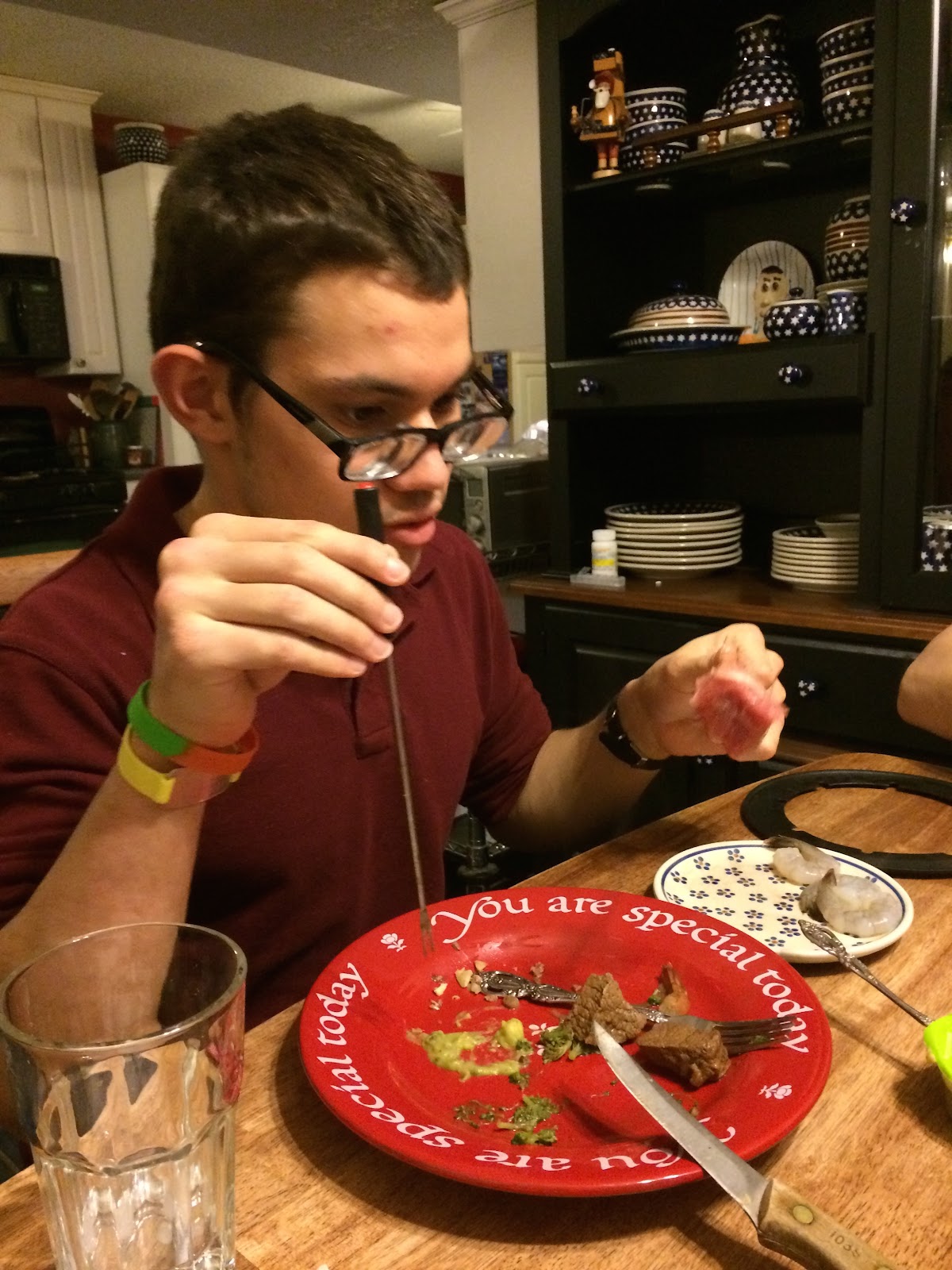
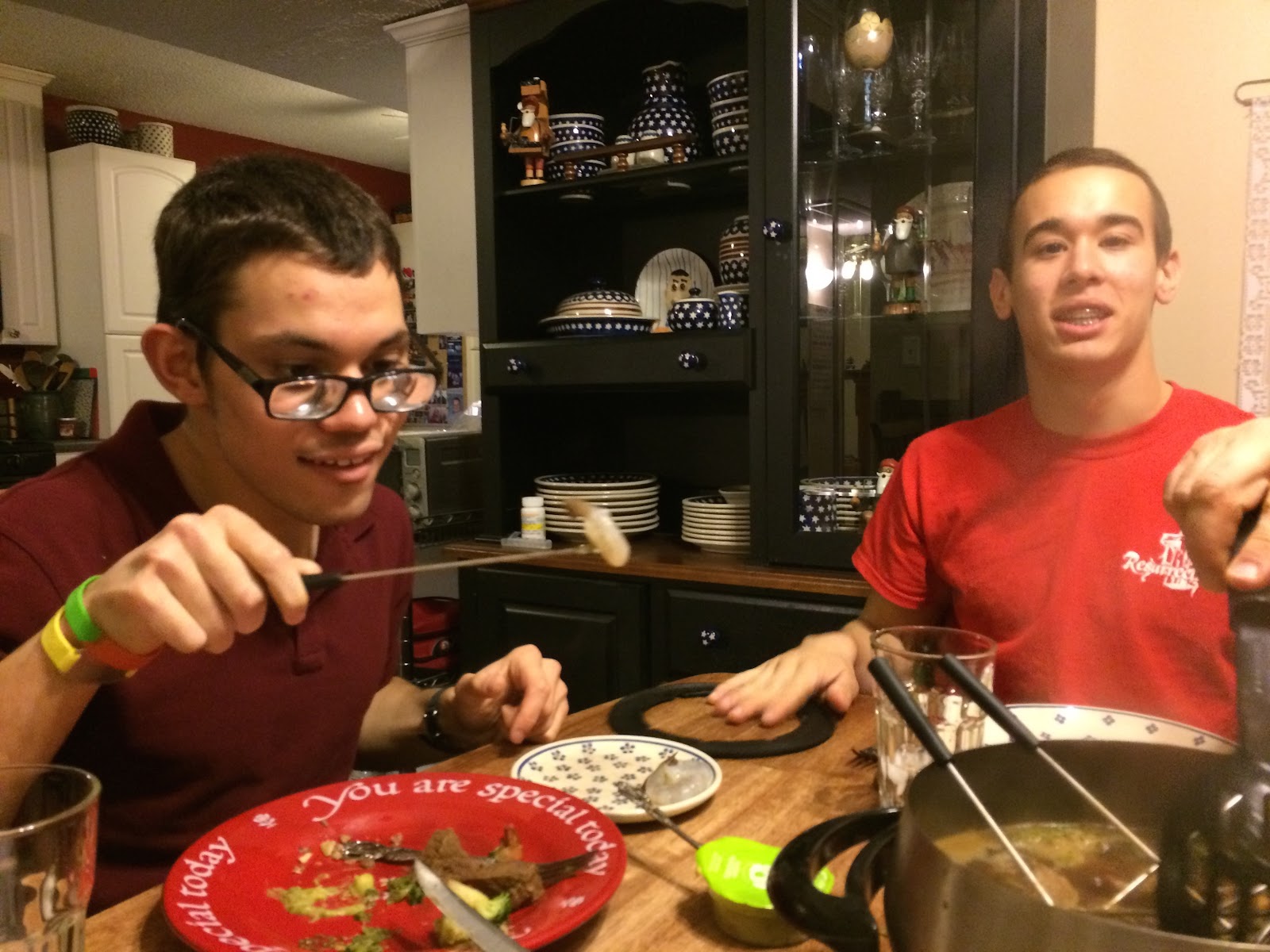
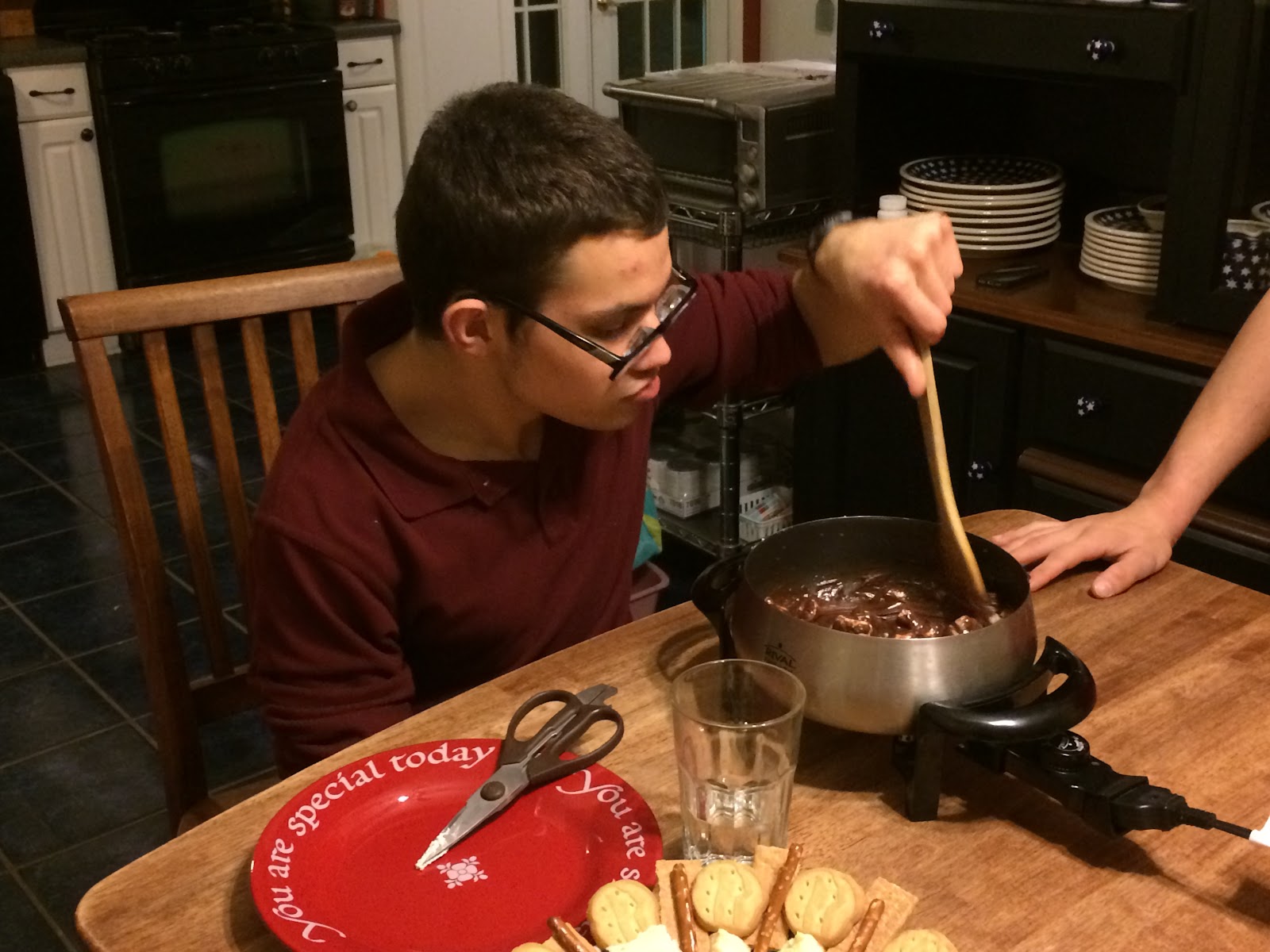
When we were celebrating S’s Gotcha Day with fondue, I was watching him stir the pot, literally, and I grabbed my phone to take a picture. 
“Really, mom?  What could you possible blog about with this?”  
Oh, I had an answer. "Cooking and therapy - a perfect match."

IMG_1046.jpgIMG_1048.jpg


IMG_1050.JPG


When S was a fifth grader, he worked on food preparation skills in Occupational Therapy.  He exited OT as an early middle school student.  Last year, we had him start again.  We asked that they work on helping him with cooking skills and strategies.  S’s goal is to live independently; therefore, he needs to be able to eat.  Contrary to his thinking, food just does not appear in the refrigerator in single serve reheatable containers.


Last year's Occupational Therapy services were very beneficial to him.  The OT has children who are college age, so she was able to provide S with real world examples of the need to cook.  She had him preparing different food items for the staff at the clinic (biscuits, brownies, etc.).  One day we met at one of this organization's Rehab facilities so she could monitor him in a full size kitchen.  She was impressed with how much he could do.  It also showed her areas to continue working with him.  


One of the most difficult areas for S is baking.  There is a lot of planning and movement around an oven.  The OT brought in a toaster oven for him to try.  That worked very well.  S now has his own toaster oven.  When he uses it, he puts a chair in front of it so he can sit while he is maneuvering pans in/out of it.


We have S prepare single serve containers of food items from larger quantities:  yogurt, granola, meal items. We also have him cook large meals and divide things up. He is a fan of "one bowl" meals. He will mix all kinds of things together.


Through the years, we have tried different kitchen items for S.  In addition to his toaster oven, he likes the following:
Ove Gloves :  S loves these for his toaster oven!  Oven mitts are difficult for him to put on, and he feels unsure of himself when he is wearing these.  With the Ove Gloves, he is very comfortable working with the toaster oven and hot pans.  If he is comfortable, he is relaxed.  If he is relaxed, his tone doesn't kick in.  If his tone doesn't kick in, he can move much better.
Pampered Chef Small Micro Cooker:  This has a handle and a lid.
Rubbermaid containers:  These are S's best tool in the kitchen.  It allows him to carry his food without spilling as he walks (remember he's walking with crutches).  
Tervis Tumblers:  Easy for carrying drinks.
Ziploc bags

For S, the therapeutic benefits are extensive.  He is working fine motor (cutting, stirring, peeling, measuring, pouring), gross motor (moving around the kitchen safely), motor planning (how to carry things from A to B), executive function (what items do I need, creating lists, planning a shopping trip), and paying attention to time (how long does something need to cook and what else needs to be done in that time).

I think I will hang out on the couch with chocolate and let S work in the kitchen.


Linking up with:


Thursday, February 12, 2015

How S Learned to Write His Name

When S joined our family in 2001, he was 4 years old and ready to start Pre-K.  He was so excited about school that year, and his focus was on learning English and charming everyone at the school.


The summer before Kindergarten started we knew he needed to learn to write his name. During Pre-K, the teacher or the aide wrote his name on his paper for him.  That was fine that year, but he needed to learn to write his name.
[S did receive OT services at school, but there were so many other areas that he needed to work on before we focused on writing skills with the OT.]


What did we do?
We told S that we had to practice writing every day during the summer so he would be able to write his name on his paper like the other boys and girls did.  He was good with that.  Every day he got up on his stool at the table, and we pulled out the bucket of handwriting helps.


What did we use?
Since our primary focus at that point was his name and not all of the letters, we had a very specific goal.  Fortunately, the letters in his name aren't too difficult to make.  


Techniques we used included:
*Spelling his name out with shaving cream or pudding on the table
*Tracing the letters in his name on papers I made
*Tracing the shapes of his letters on sandpaper for the tactile sensation
*I made bubble letters on paper and outlined them in glue.  This provided "bumpers" for his letters which forced him to stay in the lines and create the right shapes.
*Taping paper on the wall and having him stand to write
*We tried a variety of writing tools - crayons, fat pencils, regular pencils, markers.
*S is left handed, so there is a slight challenge with that.


We probably did some other things, but that's what I can remember.  It's been a while since we did that.


Beyond His Name
We used Handwriting without Tears for him to learn to write the rest of his letters and numbers. Knowing that S would use computers/keyboarding for his primary writing, we knew that he still needed functional handwriting.  


He went through the Handwriting without Tears book, and we progressed to cursive.  We knew that he would need to be able to sign papers as he became older.  We have found that a felt tip pen works best for him when signing his name.  It allows for a better flow across the paper.


I don't know if he remembers how many hours we spent at the table, so he could learn to write his name that summer.  He was quite excited to show his teacher when Kindergarten started. He has worked very hard and has come a long way!


I will be on the couch with chocolate celebrating the little milestones that came because of hard work on my son's part.

Linking up with:


Thursday, January 15, 2015

Therapy at 18 Years Old


Today I will be joining up with some friends at As He Leads is Joy for Therapy Thursday. Therapy has always been a way of life for our family since S became part of our family when he was adopted from Bulgaria at the age of 4. Every week was filled with multiple PT, OT, and Speech sessions, privately and at school.  This has been our life for many years. Today, however, we are at a different point in our life with S’s therapy.


What does therapy look like now?
S is now 18 and a senior in high school.  He has always had PT including the time he spent in an orphanage.  He has done OT and Speech off and on throughout the past 14 years as we have deemed necessary.  He has now been exited from all therapies; however, that doesn’t mean he is done with therapy.  He is currently responsible for doing things on his own (with a FEW reminders from his parents).


What does S do on his own?
Physical Therapy:  S needs to stretch daily.  Some days are better than others.  He knows the importance of stretching.  He can feel a difference in his body when he does it.  S also partakes in physical activity:  Wii boxing up on tall knees, adapted Pilates to work his core, riding horse weekly at a therapeutic riding facility, walking. I think chair yoga would be beneficial for him.  We will see if he is willing to try that at some point.


Occupational Therapy:  S works on living skills required for independent living, functional writing (signing checks and/or papers), putting his clothes away, carrying things with one hand to/from the table, etc.


Speech:  S sometimes needs verbal cues from us to make sure he is using good breath support and enunciating words clearly. This is helpful for speaking with others and when he uses Dragon Dictation.  He has strategies he needs to continue to use if his body locks up which prevents him from speaking. He has a foam bolster he lies on to help stretch himself out which helps his speech.


What else?
We are currently working on improving S's executive function skills.  It is a struggle for him. We are reading the book, Smart but Scattered Teens:  The “Executive Skills” Program for Helping Teens Reach Their Potential.  We made it through Part I before Christmas, “What Makes Your Teen Smart but Scattered”.  My husband and I are now reading Part II,  "Laying a Foundation That Can Help", and we are looking forward to getting some helpful implementation pieces. This is an area that is very important to us given S’s age and the fact that he plans on attending college next year.  

I'm looking forward to next Thursday! Until then, you can find me on the couch with chocolate!



Tuesday, September 23, 2014

It wouldn’t be fair to the other kids.

IMAGINE:
Imagine being the parent of a child who has special needs.  This child can’t walk like the other kids.  He can’t run.  Writing is very difficult for him.  Speaking is difficult for him (hard to believe if you have spent time with him).  He has vision issues.  Every task for him is difficult to achieve, but he does it.  Everything he does takes much longer than it does for a child without special needs; his life would be easier if we did these things for him, but it wouldn’t be beneficial for him.  This is a child who could have had reduced assignments given to him in school, but he refused that accommodation as an elementary school age child.


IMAGINE:
Now imagine being the parent of this child as you sit in a school meeting trying to make sure he is receiving his “free and appropriate education” which is mandated by law.  [You haven’t experienced fun until you have had to sit through IEP meetings (sarcasm button).]  Imagine that you ask for some basic accommodations to try to level the educational field in which your child is expected to play and you are told by a school employee or someone from the state that the accommodation you are asking for “wouldn't be fair to the other kids.”  What?????  


You are seriously telling me that asking for my child to have accommodations put in place to access his education won’t be fair to the other kids.  We aren’t asking for anyone to do his work. We aren’t asking for him to be excused from work or tests.  We have already established that he wants to do the same work as the other kids.  We are asking for tools to be put in place for him to do the work and prove that he can do the work.


CALIFORNIA:
S’s second grade class took timed math facts tests.  They had to solve 100 facts correctly in 5 minutes in order to move to the next level.  There was a big bulletin board in the room showing their progression, and it was a BIG deal to have your name moved up to the next level.   They took these tests on Wednesday afternoons.  


Because of S’s CP, his fine motor skills are impacted, and he has functional handwriting which doesn't include writing for a timed test.  He had an aide who came in to write for him during these timed tests.  While the other kids had to write for themselves during the 5 minutes, S had to tell this adult the answers and wait for her to write them during this same time.  If the kids missed any, they had to repeat the same facts the next week.  Getting 99 facts right in 5 minutes was not acceptable!  


There were a couple of weeks that this aide was unable to come into the class during this time; therefore, S was expected to write for himself during the timed math test.  There was no way he was going to pass because he can’t write fast enough to complete 100 problems in 5 minutes.  We asked the teacher if he could have a little more time during tests where he was expected to write for himself, so he could have the satisfaction of passing without anyone writing for him.  “That wouldn’t be fair to the other kids.”  Are you kidding me?????  Forget the fact that he has an IEP that states he gets additional time on work and tests.


VIRGINIA:
Because S has fine motor issues, writing is extremely difficult for him (see above).  To solve math problems, we used graph paper with large squares. We would write the problems out so they were lined up, and he could solve them independently.  This was how he did math.  


We asked for him to use graph paper on his Math SOL (standardized test).  We had to submit the graph paper we wanted him to use.  We also submitted two math samples for S:  1.  One using the graph paper where the problem was solved correctly because his numbers were lined up.  2. One using regular paper where the problem was solved incorrectly because his numbers were all over the place.  


The state of Virginia told us that "it wouldn’t be fair to the other kids" because it was homemade graph paper and not store bought.  


Kudos to our principal for being brave enough to tell me that piece of information face to face. Kudos to me for not completely losing it in the school hallway.  I asked the principal if the state was testing math skills or writing skills.  I told the principal that “those people” need to come and spend one day in school with S to see what it is like for him to get through a school day.  I also asked the school if they could make the graph paper so it wouldn’t be homemade.  The reason we had to make it is he can’t write small enough for the graph paper sold in the stores. If he could write that small, we wouldn’t need it.


VIRGINIA:
Due to the level of his needs, S requires a number of accommodations to level his playing field.  It was extremely frustrating his fifth grade year as we went back and forth with the state trying to get his accommodations in place for the SOL testing that they require.  I remember telling our principal at the time, “We can’t possibly be the first people in the whole state to ever ask for these accommodations.”  His response, “You might very well be.”  He told me that most kids who have required the quantity of accommodations that S does typically don’t have the cognitive functioning that S does. (http://onthecouchwithchocolate.blogspot.com/2014/07/tell-us-little-about-your-son.html)


S is very aware of the challenges his special needs bring to his life.  He also knows he is entitled to accommodations by law.  He isn’t asking for an easy way out.  He is looking for ways to level the playing field for himself so he can be educated and become part of the work force.  The paralympics finds ways to level the playing field for their athletes.  You think society would realize that’s all we want for our son instead of telling us “it’s not fair”.


Is it any wonder I need time on the couch with chocolate (and wine)?